 Arcwoven
 GUIDE Architecture methods
C4 model vs SysML v2: which architecture approach fits?
C4 and SysML v2 are often mentioned in the same architecture conversation, but they are not interchangeable competitors. C4 is a lightweight way to communicate software structure at useful zoom levels. SysML v2 is a formal systems modeling language. The right choice depends on what your model must communicate and what engineering decisions it must support.
Arcwoven is currently in public beta. Repository analysis is limited to the TypeScript/TSX, Node, and React pilot. The product derives provisional model state from public GitHub repositories for human review; it does not treat automated output as authoritative.
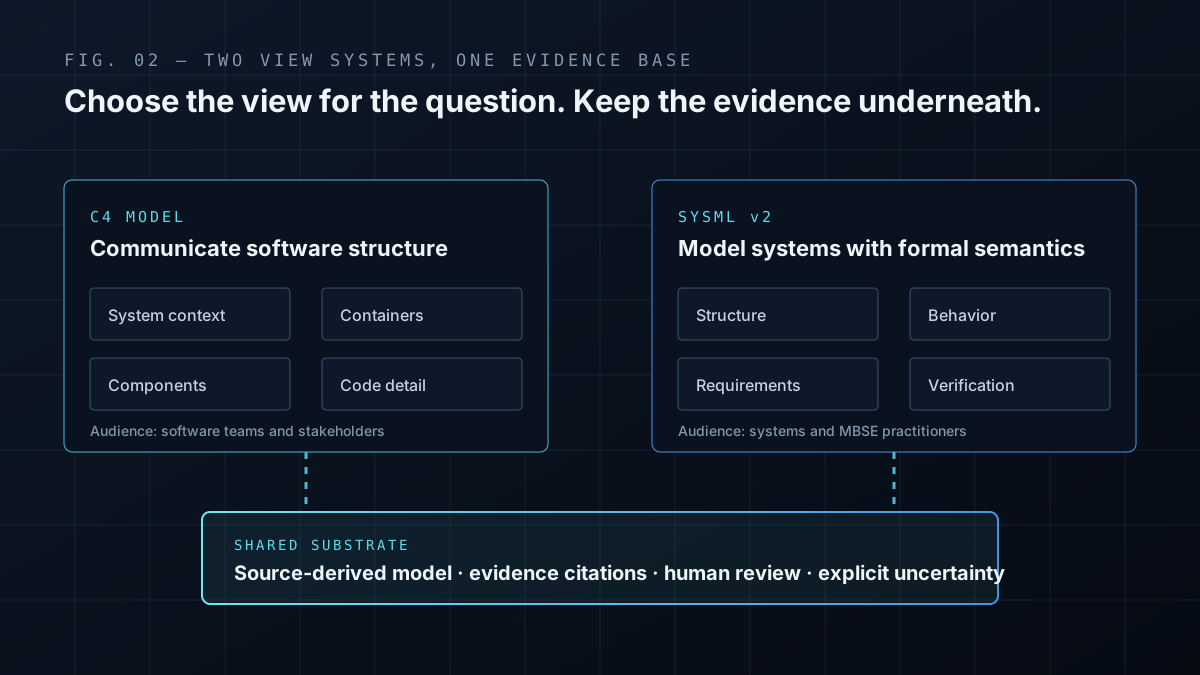
The short answer
- Choose C4 when you need clear software architecture diagrams for developers, operators, stakeholders, and adjacent teams.
- Choose SysML v2 when you need a standard, semantically defined model for systems engineering across structure, behavior, requirements, interfaces, and analysis.
- Use both when software architecture must remain understandable to a broad audience while also participating in a formal system model or MBSE workflow.
What the C4 model is
The C4 model is a developer-friendly approach to visualizing software architecture. It defines hierarchical abstractions and diagrams for system context, containers, components, and code, plus supporting landscape, dynamic, and deployment views. It is both notation-independent and tooling-independent.
Its strength is communication. A context diagram shows the system, its users, and the external systems around it. A container diagram zooms into applications and data stores. A component diagram can explain the responsibilities inside one container when that extra detail adds value. The official guidance recommends context and container diagrams for most software development teams and treats deeper levels as optional.
What SysML v2 is
SysML v2 is the OMG Systems Modeling Language version 2. It provides a formal language for describing systems with graphical and textual notation. Its scope extends beyond software structure to system behavior, requirements, interfaces, analysis, and relationships across engineering disciplines.
The official SysML v2 release also includes a standard API and services specification, example models, and model libraries. That makes SysML v2 a foundation for interoperable modeling workflows rather than only a drawing convention. The OMG Systems Modeling Community release repository is the practical starting point for current specification documents and incremental reference releases.
C4 and SysML v2 compared
They answer different questions
A C4-style architecture conversation asks: What is the system? Who uses it? Which applications and data stores make it work? How are responsibilities divided? Those are exactly the questions a software team needs when onboarding developers, planning change, or explaining operational ownership.
A SysML v2 conversation can go further: What requirements does the system satisfy? Which parts and interfaces define it? What behavior and states matter? Which analyses constrain design decisions? How does the software participate in a larger engineered system?
This difference means a team should not force every stakeholder into a formal systems model, and should not expect a lightweight diagram set to carry all the semantics of an MBSE model.
How teams can use C4 and SysML v2 together
- Start from one reviewed architecture model. Establish boundaries, services, interfaces, stores, and dependencies, each grounded in evidence.
- Use concise views for communication. Present system context and software structure at the zoom level each audience needs.
- Carry reviewed structure into SysML v2. Use the standard textual or graphical language when the architecture must connect to formal systems engineering.
- Keep differences explicit. C4 concepts and SysML v2 concepts do not map one-to-one; preserve meaning instead of mechanically renaming boxes.
- Review changes against source. When implementation changes, derive a new candidate state and confirm it before updating trusted views or models.
Where source-derived evidence fits
Neither a diagramming method nor a formal modeling language guarantees that a model matches the implementation. Traceability is a separate concern. For an existing software system, repository evidence can anchor boundaries, services, interfaces, data stores, and dependencies to the code that implements them.
Arcwoven uses that repository-to-model layer as its starting point. It imports a public repository, derives provisional model elements, and attaches the source evidence behind each claim. A person then reviews the result. The reviewed model can support architecture diagrams for communication and can be exported as SysML v2 for further refinement in a systems-modeling toolchain.
Current Arcwoven scope
- Pilot languages and frameworks: TypeScript/TSX, Node, and React only.
- Repository access: public GitHub repositories today.
- Review posture: generated outputs remain provisional until human-reviewed.
- Free-account limits: 2 imports per day, 6 per week, and 10 per month.
- Export: diagrams, documents, HTML, and SysML v2 are Pro features.
Build the model before choosing the view
Try Arcwoven on a public TypeScript, Node, or React repository. Review the evidence behind each architectural claim, then choose the diagrams or SysML v2 export your workflow needs.
Related guides
FAQ
Is C4 an alternative to SysML v2?
Not directly. C4 is a lightweight, notation-independent way to communicate software architecture at several zoom levels. SysML v2 is a formal systems modeling language with textual and graphical notation, a defined metamodel, and standard API services.
When should a software team use the C4 model?
Use C4 when the main need is to explain software-system context, applications and data stores, components, and selected implementation detail to technical and non-technical audiences.
When should a team use SysML v2?
Use SysML v2 when the work requires a formal system model that can represent structure, behavior, requirements, interfaces, analysis, and cross-disciplinary relationships in a standard language.
Can C4 and SysML v2 be used together?
Yes. A team can use concise software architecture views for communication while carrying reviewed system structure into a SysML v2 model for formal systems engineering.
Does Arcwoven generate authoritative C4 or SysML models automatically?
No. Arcwoven derives a provisional architecture model from repository evidence. A person reviews it before relying on or exporting it. Arcwoven exports SysML v2, diagrams, documents, and HTML as a Pro feature.